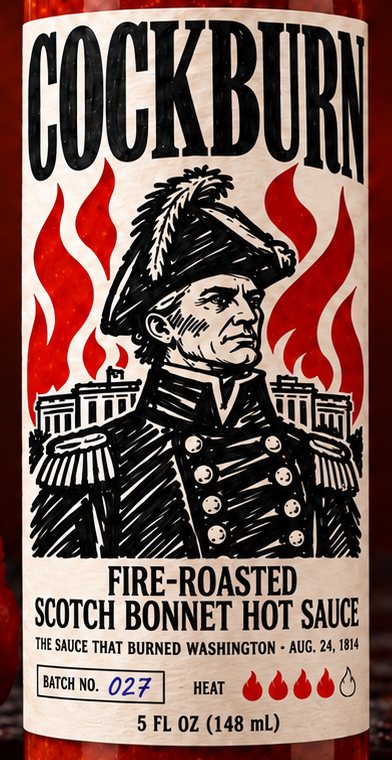
A bottle of Cockburn fire-roasted Scotch bonnet hot sauce with a black wax-dipped cap on dark stone beside a red Scotch bonnet. The label shows a Sharpie drawing of the stern admiral before red flames and the White House.

Cockburn

Fire-roasted
Scotch bonnet hot sauce

Admiral Cockburn burned down the White House in 1814. Yes. Really.

Heat 5 fl oz · Wax-sealed Made for D.C.

It’s pronounced “Co-burn.”

Nobody believes us either.

Hot

Red Scotch bonnets, the Caribbean's own pepper. Fruity first, then a long climbing burn. Four flames out of five.

Good

Half the peppers fermented for depth, half charred over flame, then navy rum, lemon and Jamaican allspice. Built to go on everything.

True

On August 24, 1814, Rear Admiral George Cockburn really did burn the White House. Yes, that was his name.

The Cockburn label: a Sharpie drawing of the stern admiral in his bicorne, red flames and the White House behind him, under the word COCKBURN.
24.08.1814

The night the President's House burned

On a summer evening in 1814, British troops marched into Washington. With them rode Rear Admiral George Cockburn, who had spent the war raiding the Chesapeake and had little patience for American pride.

By midnight the Capitol was ablaze and the President's House was gutted. Dolley Madison had fled that afternoon, and a portrait of George Washington was saved from the walls on the way out.

Legend says the admiral then had a newspaper that mocked him destroy every letter "C" in its type, so it could never print his name again. We've printed it on every bottle.
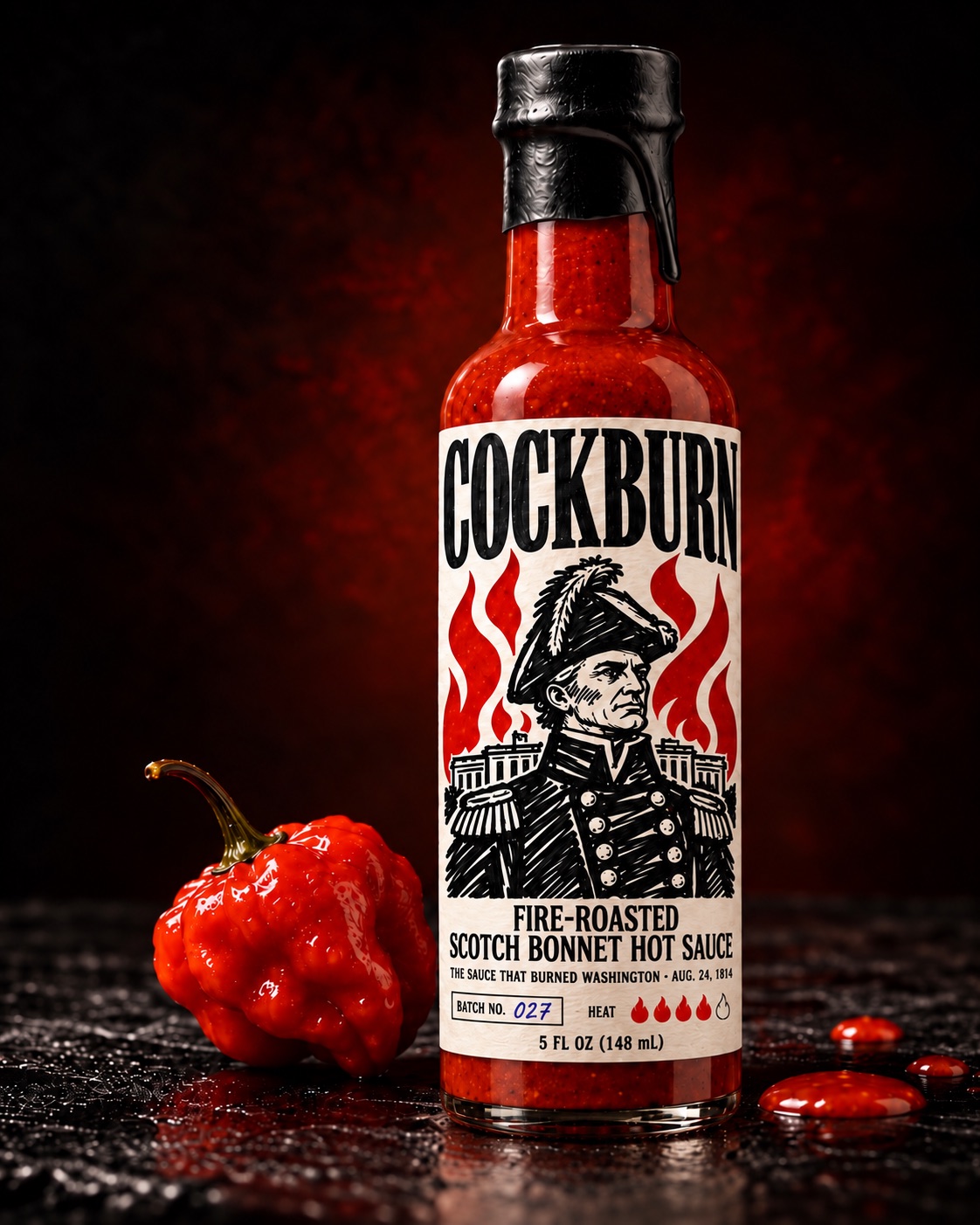
A bottle of Cockburn fire-roasted Scotch bonnet hot sauce with a black wax-dipped cap on dark stone beside a red Scotch bonnet pepper.
The Sauce

Heat from the Caribbean

Before he ever saw Washington, Cockburn learned his trade in the West Indies. The recipe follows his route.

So we start with the Caribbean's own pepper: red Scotch bonnets, half fermented and half charred over flame. Then a splash of navy rum, lemon (the Navy's ration in his day; limes came later), Jamaican allspice and thyme.

Pepper
Fire-roasted Scotch bonnet
With
Navy rum, lemon, allspice, thyme
Size
5 fl oz (148 mL), wax-sealed
Heat
Get the first batch
For Shops

The souvenir people actually use

Every visitor to Washington hears about 1814. Now they can take it home. Cockburn is made for D.C. gift shops, museum stores and markets: a true story, a name that sells itself at the counter, and a sauce good enough that they come back for another.

  • Cases of 12, with a counter display
  • Shelf-stable, sealed and gift-ready
  • A one-page sell sheet and tasting samples for your staff
  • First wholesale orders go to D.C. shops

Get wholesale details

Tell us where you are and we'll send pricing and samples before the first batch ships.

Questions

Fair questions

How hot is it?

Four flames out of five. Scotch bonnets sit in the same family as habaneros, so it's well past a supermarket hot sauce, but the fruit and rum keep it tasty rather than punishing. A few drops go a long way.

Is that really his name?

It is. Rear Admiral Sir George Cockburn, Royal Navy, 1772 to 1853. He led the burning of Washington on August 24, 1814. The British pronounce it "Co-burn." We've stopped correcting people.

What goes on it?

Eggs, tacos, wings, grilled fish, jerk chicken, pizza, a Bloody Mary. Anything that could use a little bit of a British invasion.

When can I buy it?

The first small batch is in the works. Join the list and you'll get one email when it's ready, before it reaches shops.

Where will it be sold?

Here online, and in gift shops around Washington, D.C. If you run a shop, get wholesale details.

First Batch

Get the first bottles

Get the first batch